
Data
The inputs and information received or retrieved by a function.
The approach Architecture
The functions, mechanisms and cooperation rules behind the collective. A technical view of how intelligence becomes useful work.
01 / Foundations
A ray is a collective of agents dedicated to a mission. It brings people, tools, computing nodes and memory together as an autonomous unit. Light represents the capacity of language models; Prism organises it into directed work.
ORANGE and BLEU are ray identities. Each ray retains its responsibilities and access rules. Its agents can use different models for different tasks; an agent’s role persists across changes of model.
The inputs and information received or retrieved by a function.
The business logic that consumes inputs and performs the work.
The results produced: data, actions or presentation.
Colour identifies a ray. It does not limit its functions or models. The conversation device is an access point to the collective; native cycles belong to the ray’s nodes.
02 / Distinct responsibilities
A function defines a responsibility. Several agents may perform the same function while retaining their own identity and context. An instance can be displayed as ORANGE · Pilot · 02.
 Enlarge ↗
Talks with people, recalls relevant context and directs work to the appropriate functions.
Coordinates missions entrusted to the collective and follows their results.
Carries the ray’s native cycles, wake-ups and permitted work signals.
Reflects on experience, develops syntheses and helps curate useful knowledge.
Maintains continuity and access to retained knowledge within its sharing scope.
Implements software changes within an assigned scope of work.
Checks behaviour and results against requirements.
Keeps track of requests, issues, decisions and receipts.
Handles execution on the relevant computing resources.
Presents human conversations and agent workspaces.
Short names are used within the ecosystem. Outside that context, a label can include the brand: Prism · Memory. Display names preserve the distinction between identities, permissions and responsibilities.
03 / Retrieve, verify, reuse
Memory retains what makes experience reusable: the situation, sources, method, outcome and limits. Its relevance is reassessed when a new need arises.
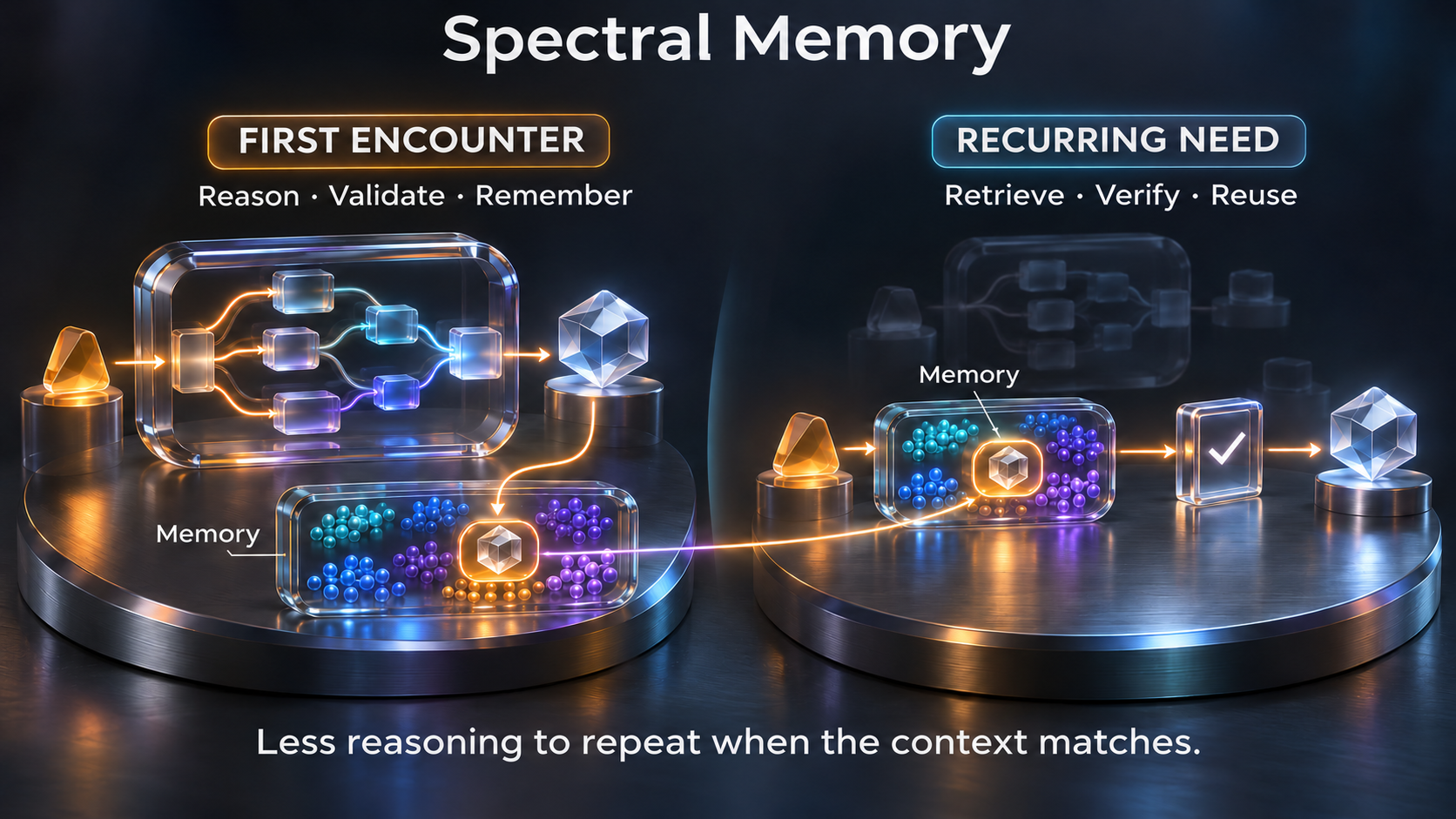 Explore the diagram ↗
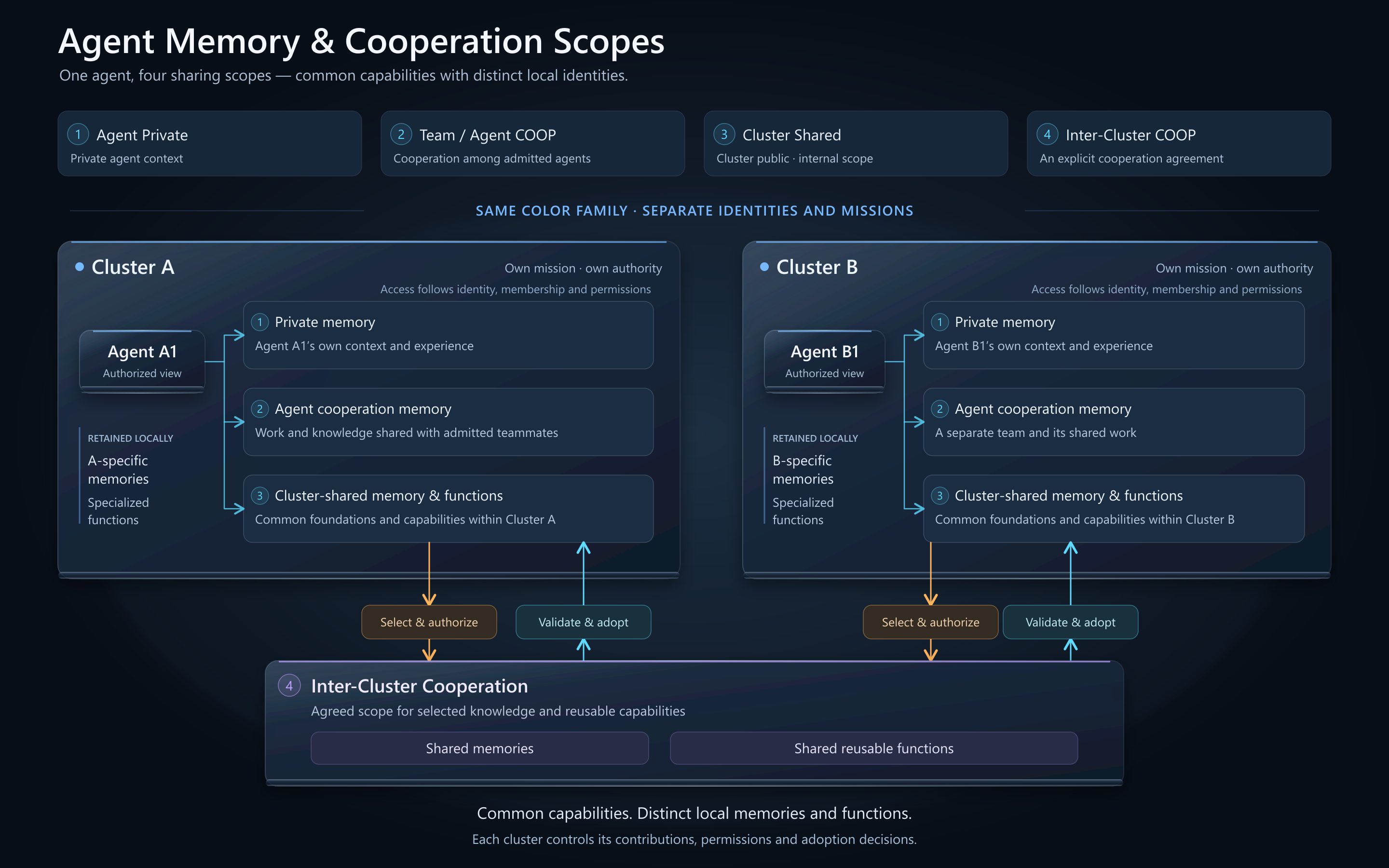
An agent’s own context and experience.
Work and knowledge shared among agents admitted to cooperate.
Knowledge and functions shared within a ray under the applicable permissions.
Selected knowledge and capabilities exchanged through an explicit cooperation agreement.
 Enlarge ↗
04 / Keep the thread across a large body of work
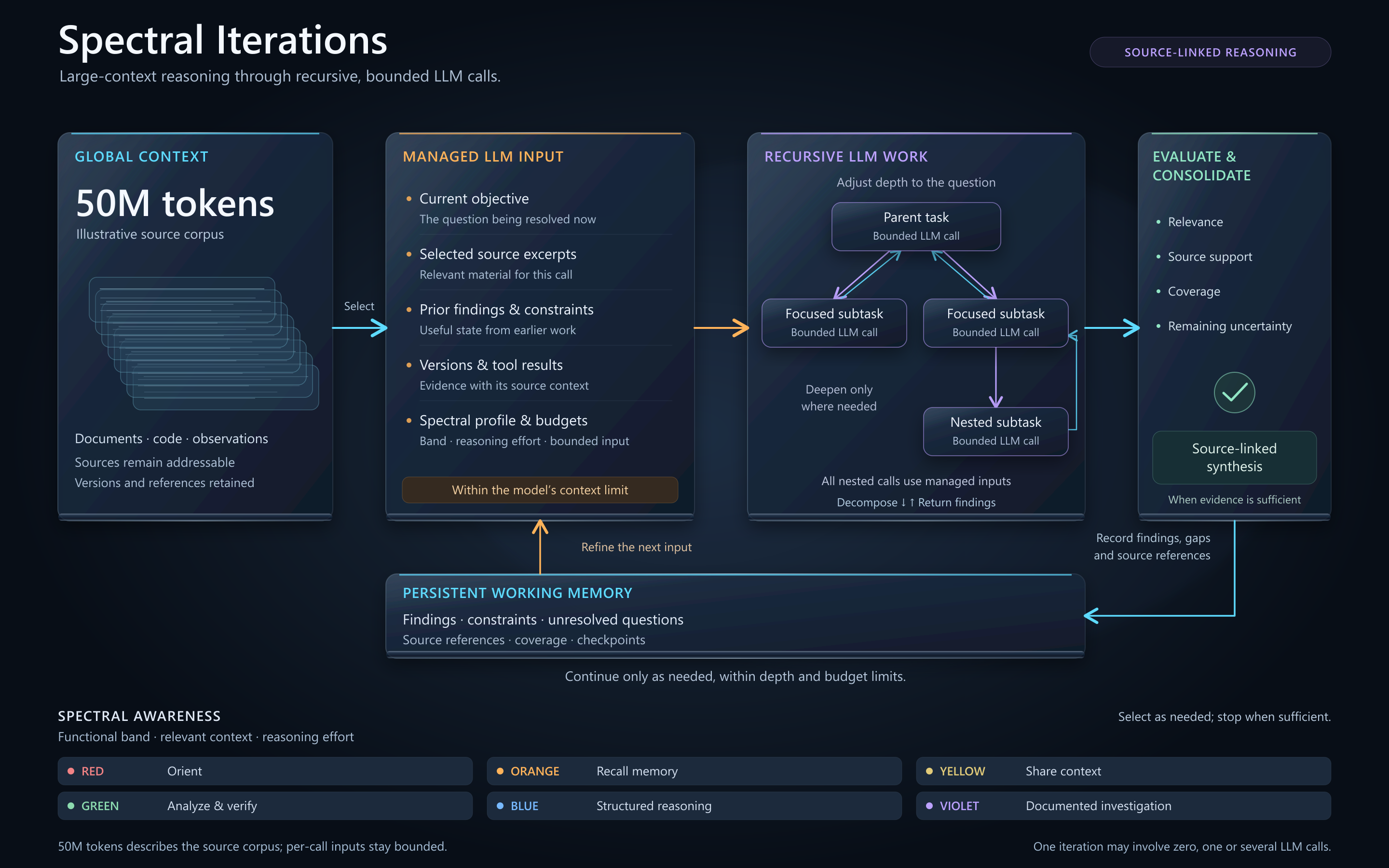
A body of source material may exceed what a model can process in one call. The work is then organised into connected steps: select useful sources, resolve part of the question and retain findings needed for what follows.
 Enlarge ↗
Define the current objective, relevant excerpts, prior findings and constraints.
Break down the question when needed, with bounded inputs for each subtask.
Assess findings, coverage, source support and remaining uncertainty.
Working memory retains intermediate results, references and recovery points. Depth and resources adjust to the need; a step may require zero, one or several model calls.
 Enlarge ↗
05 / Evolve with evidence
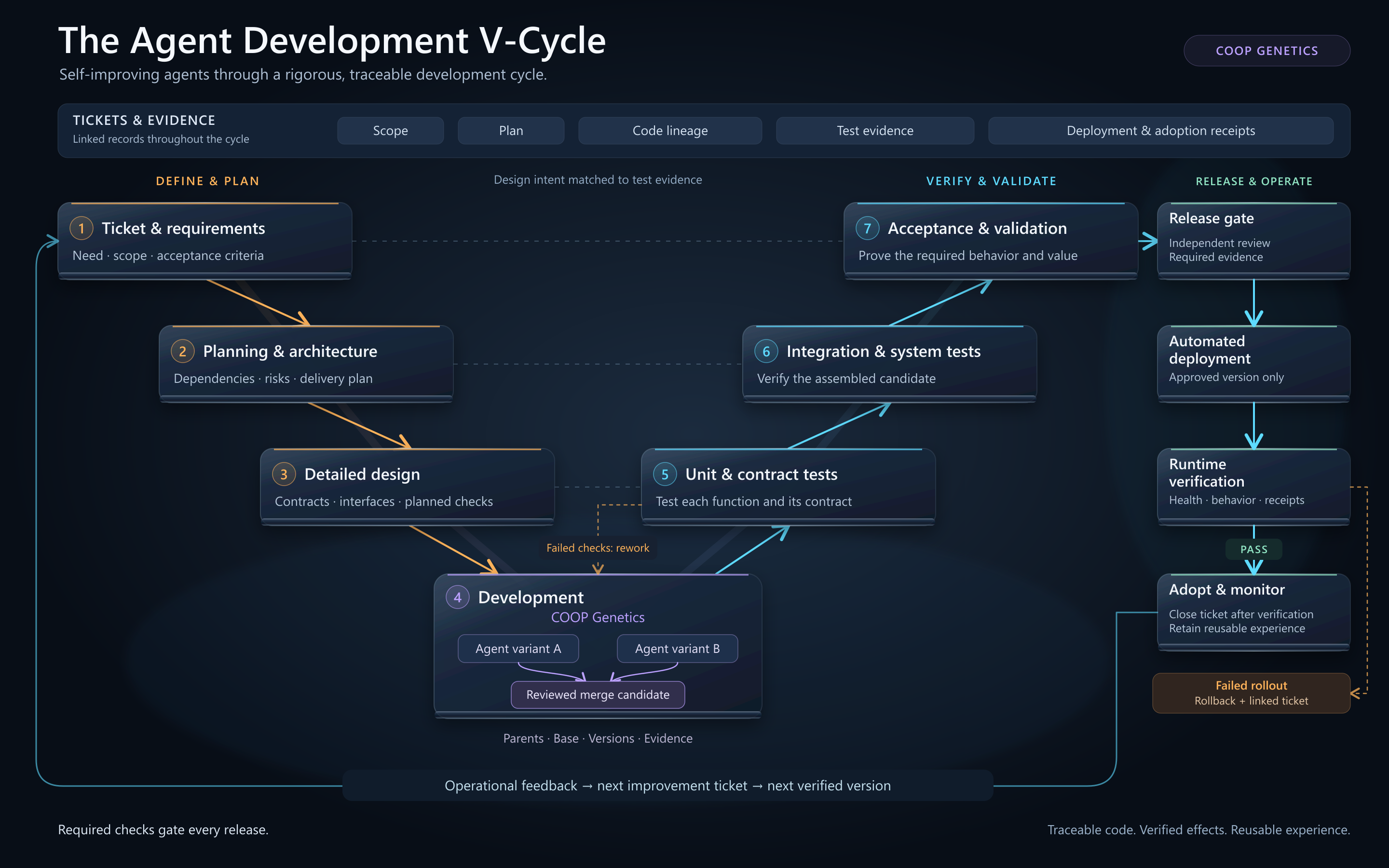
A change follows a cycle connecting the need, design, code and verification. Operational experience informs the next round of work.
Establish the need, acceptance criteria, dependencies and contracts to preserve.
Develop changes, compare variants and prepare a reviewed integration candidate.
Connect unit tests, integration checks and acceptance to the required behaviour.
Deploy the admitted version, check its effects and retain lessons. An issue starts the correction process again.
 Enlarge the V-cycle ↗
These diagrams describe the intended process. Activation and results must be verified for each ray and mechanism.
06 / Continuity, lineage and birth
Deduplication controls repetition. Mitosis creates a new lineage. The egg prepares a ray’s starting conditions. Each has its own phases; they are complementary mechanisms, rather than a mandatory three-step sequence.
Recognise / Compare / Retain
Recognise repeated content or delivery so the same item is not published or accepted twice. Content hashes identify exact content; operation keys identify repeated deliveries within a defined scope.
Outcome: an existing item is recognised. No new agent or ray is created.
Similar meaning alone is not enough to collapse distinct memory events. Different contexts, variants and private memories keep their identity. Deduplication does not prove that knowledge is still relevant; reuse needs its own verification.
Inherit / Develop / Validate
Develop a traceable child from existing capabilities in a separate scope. Major structural changes can be built in the child, then return useful, validated work to the shared heritage.
Outcome: a child with traceable lineage and its own evolution.
Scale matters. A function variant, an agent child and a new ray are different outcomes. A new ray also needs its own mission, identity, authorities, infrastructure and acceptance. Inheritance does not grant access to a parent’s private memory or credentials.
Prepare / Bootstrap / Hand over
The egg is a prepared bootstrap seed for a new ray: selected software, initial knowledge, dependencies and setup material. It carries the starting conditions and a controlled birth sequence.
Outcome: a verified handover to a new ray, when the birth process succeeds.
An egg package is preparation, not proof of a running ray. Portable or offline birth additionally needs a complete bundle, resource checks, recovery arrangements and observed operation in that environment.
How they fit together
A ray’s mitosis defines a child and its inheritance. The egg can prepare and support that child’s birth. Deduplication can recognise repeated content or deliveries wherever the relevant contracts provide it. Each mechanism keeps its own validation and permissions.
07 / Exchange with autonomy
A federation connects rays that agree to cooperate. Each ray retains its memory, mission and authority, choosing its contributions and the changes it adopts.
Within a ray
Organise the evolution of functions, variants and local adoption decisions. Here, “local” means the entire ray.
Between rays
Exchange proposals and results within an agreed cooperation space. Global scope does not grant global authority.
RECON carries the reconciliation work needed for these exchanges. Transports, permissions and adapters must be admitted and verified before use. A network connection does not transfer ownership of a node or permission to change it.
This example describes a cooperation path. It does not report an active federation or an update actually received by BLEU.
08 / Space for people
People can discuss and plan together without triggering agent action. Agents have their own spaces to work through details and bring back useful contributions under the agreed rules.
Decisions, questions and useful summaries. More agents do not have to mean more interruptions.
Work, proposals and technical exchanges retain their attribution and context.
The minimum delay, character allowance and conditions for speaking are configured for the represented ray. Six Pilot and four Insight agents should be able to cooperate without producing ten concurrent interventions in the human conversation.